Designing trust into portfolio enhancement flow @Peppercorn
SUMMARY
Peppercorn is a pre-seed B2B fintech platform for wealth advisors managing hybrid public and private portfolios.
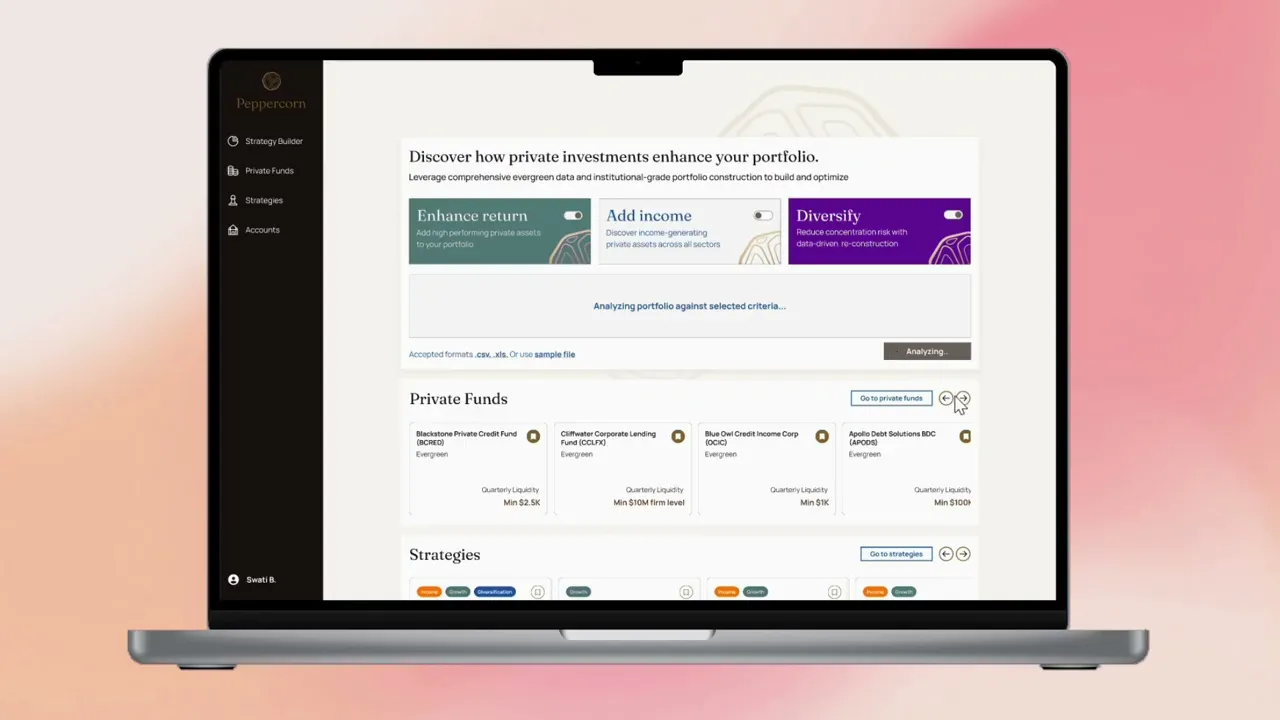
This case study focuses on the portfolio enhancement flow: the experience through which an advisor uploads a client portfolio, selects an investment objective, and receives engine-generated fund recommendations to evaluate, adjust, and act on.
Organisation
Peppercorn Solutions
Role
founding product designer
Team
Self + Founder (cto, ceo, quant r&d)
Contribution
0→1 Product ; UX R&D / FE development
core problem
The portfolio enhancement flow is built around Peppercorn’s proprietary optimizer engine. An advisor uploads a portfolio, declares an objective, and receives an engine-optimized output — a specific set of trades calculated to best achieve that objective within the portfolio's existing structure.
The output is analytically grounded but the advisor didn't build the engine, can't inspect it, and is expected to act on its recommendations in a client-facing context.
That gap between system output and advisor confidence is the design problem.
Research + Insight
dual track approach
Research @Peppercorn ran on two parallel tracks.
Track 1 : Using synthetic, agent-driven UXR to cover breadth — simulating advisor profiles across six distinct segments to surface workflow patterns, tool friction, and decision-making behavior at a scale that traditional recruiting timelines don't allow.
Track 2 : Brought in 8 design partners — practicing wealth advisors across solo RIA, ensemble RIA, and enterprise firm contexts — for structured high-fidelity user testing and in-depth feedback as the product took shape.
Scope Setting
user goals
Retain authorship over the final strategy - the output should feel shaped by them, not handed to them.
Move from uploaded portfolio to client-ready proposal within a single, uninterrupted workflow.
Have enough context at each step to make an informed decision, not just a forced choice.
business constraints
The engine is proprietary - its internal logic cannot be surfaced directly; trust had to be built through the interface.
Advisors are time-poor. The flow had to be usable in practice, not just in a controlled test environment.
The end deliverable is always a client-facing proposal. Every design decision had to serve that single downstream output.
Solving For Trust Issues
01
setting the intent
Before uploading anything, the advisor declares what they're trying to achieve — enhance return, add income, or reduce concentration risk. Uploading a portfolio without a declared goal would position the engine as an autonomous analyst.
By reversing the order — intent before data — the advisor is framing what the engine is being asked to do.


02
reviewing recommendations
The engine's output doesn't arrive as a locked result. The first thing the advisor sees is a list of positions flagged for sale* — with the ability to exclude any of them before proceeding.
*None of the trades execute immediately; they're held as a calculated proposal the advisor shapes before it becomes a strategy.

03
evaluating the outcome
The final comparison page is structured as a progressive case, not a data dump. Each section answers a different question in the sequence an advisor would naturally ask:
Did it help? (Overview)
→ Is it consistent over time? (Hypothetical Growth)
→ Is it riskier? (Risk Score)
→ What am I actually holding now? (Underlying Assets)
→ How does the mix change? (Allocation)
→ What are the specifics? (Sub-asset class exposure, Top Holdings).
Textured segments indicate newly added private fund allocations
circling it back
To further aid trust building in the UI we included a panel on the right hand side that allows advisors to see exactly what has changed — which funds were added, what moved — and keeps the generated proposal and edit strategy actions in persistent view throughout.
The advisor can act from anywhere on the page without scrolling back to find the CTA. Keeping the advisor's attention on the outcome rather than solely on the mechanics of adjustment.
(Currently in development) For advisors who want to go deeper before presenting to a client, a persistent prompt at the bottom of the page opens a conversation with Peppercorn's AI agent.